


























Sci-Fi Christian Thriller Sneak Peek:
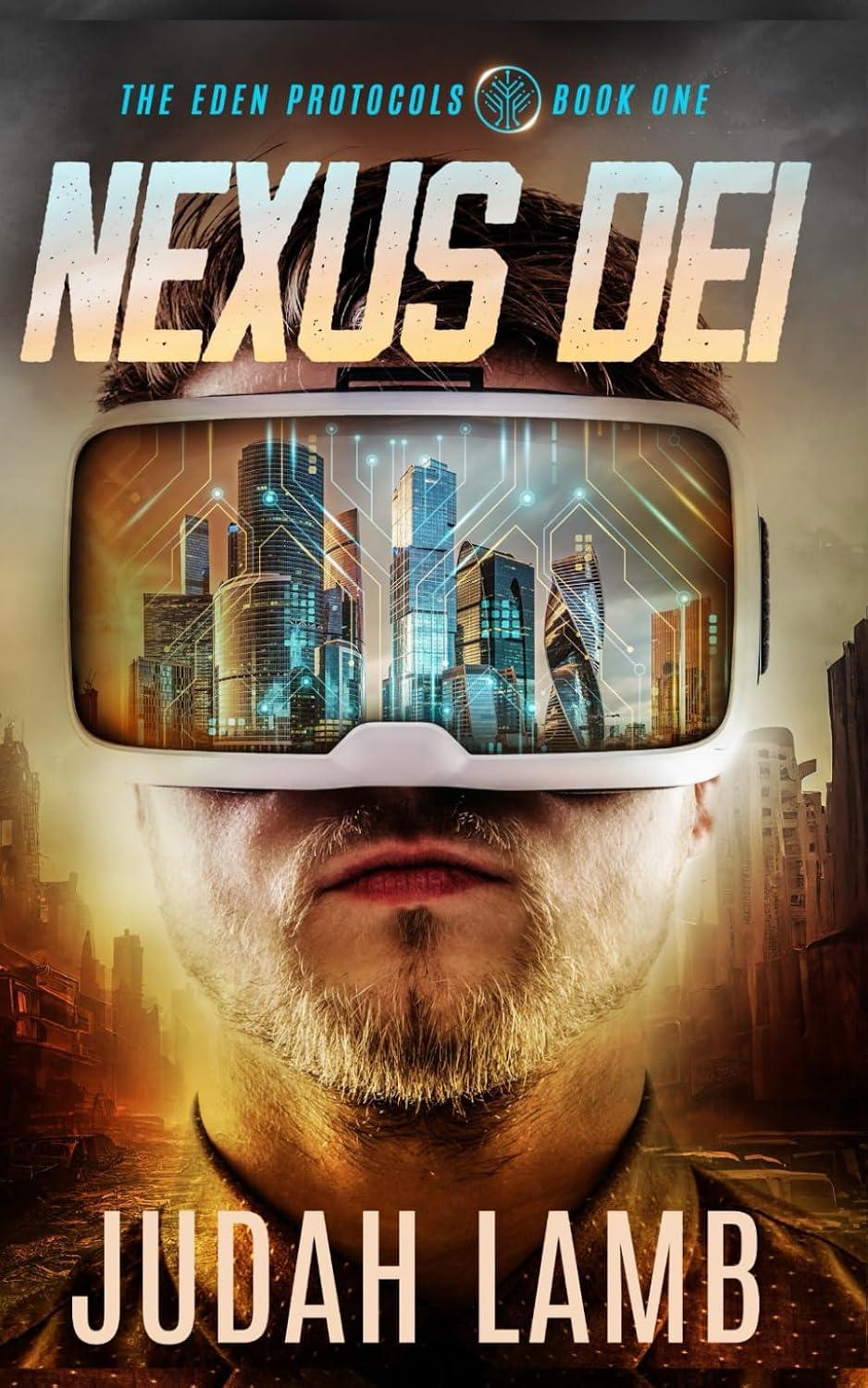
Nexus Dei by Judah Lamb
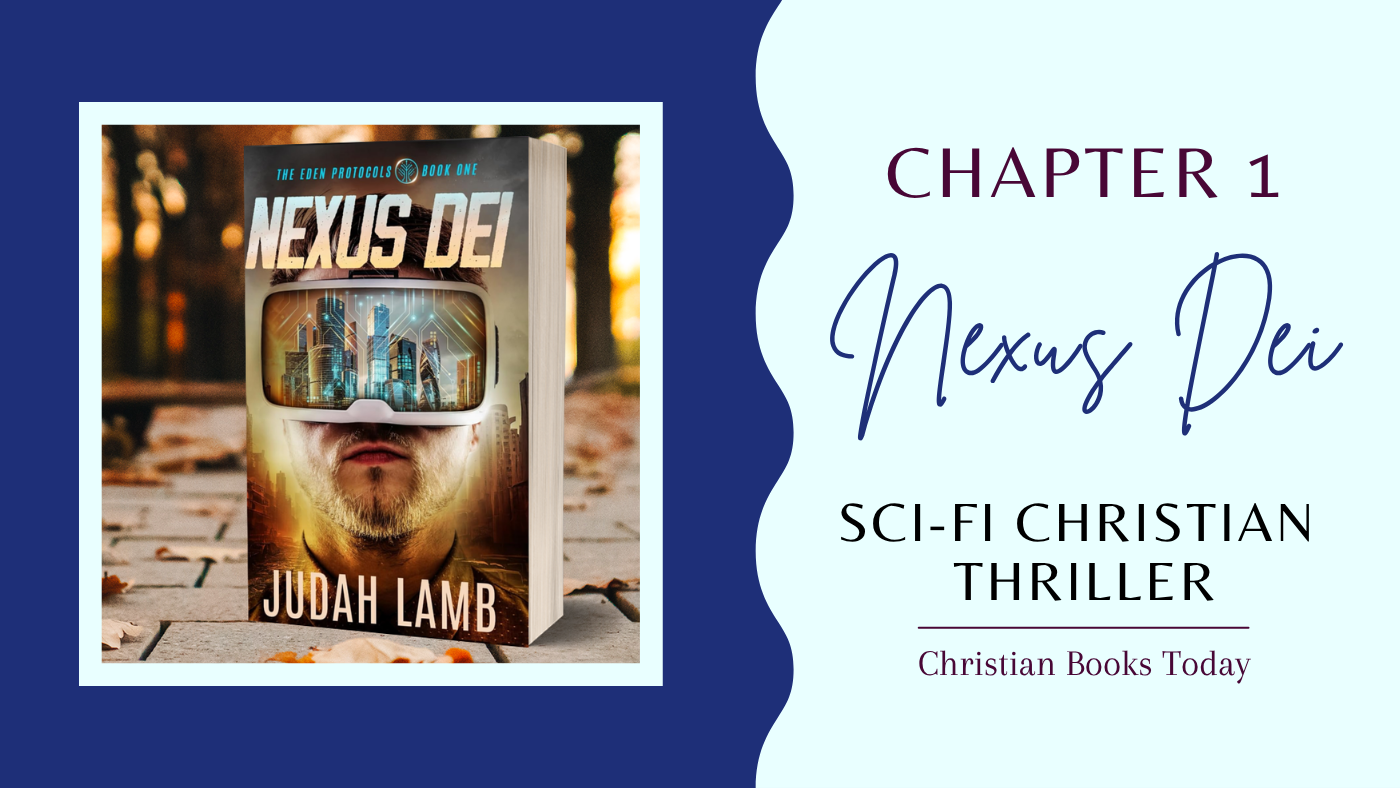
A gripping story about choosing truth—even when the lie is everything you've ever wanted ...
The last thing Elias remembered was an accident.
Now, after a two-year coma, he awakens to a world that seems almost too perfect. His family is alive, the world is finally at peace, and even Elias—a lifelong agnostic—finds himself unexpectedly drawn toward faith.
But when a mysterious priest tells him that none of it is real, Elias discovers a horrifying truth: the people he loves are AI constructs, created to keep him happy while the real world struggles to recover from nuclear devastation. Somewhere beyond this beautiful illusion, his real family may still be alive.
To find them, Elias will have to choose between the perfect life he's been given and a dangerous reality he may not survive.
Nexus Dei is the first book in The Eden Protocols, a thought-provoking Christian dystopian sci-fi thriller exploring faith, sacrifice, love, and what it truly means to be human. Fans of The Matrix, Frank Peretti's This Present Darkness, and Ready Player One will find plenty to love.

Shop from our affiliate link!
Nexus Dei: Sci-Fi Christian Thriller
by Judah Lamb
Chapter 1
There was a constant hum in the NeuroSphere Technologies lab, one Elias had learned to ignore. The sound of cooling fans, the clicking of servos, the hiss of pressurized air. The sounds all blended together. It was a sound Elias Mercer appreciated—it enhanced his focus. Unlike human voices, which distracted him. He worked before an array of holopanels, each cycling through neural map projections, each corresponding to enhanced models of replicated human consciousness.
The prototype was a glass-and-ceramic butterfly. A harmless creature, easily subdued if the artificial consciousness in its programming went AWOL. Elias steadied a micro-driver in his right hand, his left bracing the transaxial mount at exactly zero degrees. His hands didn’t tremble. Even after eighteen hours at the bench.
He made a four microns’ adjustment, then glanced at his display. The neural pathway schematic recalibrated, hundreds of glowing fibers converging, aligning, and then—
0.02% variance.
Unacceptable.
He exhaled. The room fogged around the edges of his vision. He slammed his palm down on his stainless steel workstation.
His mind drifted back to his childhood. He was nine. Sitting at the warped Formica kitchen table, staring at the yellow Froot Loops he’d selectively left off his spoon. They were supposed to all taste the same—but Elias didn’t think so. He swore they were lemon loops. Yuck.
His father sat on the opposite side of the table, but he might as well have been on the other side of the world. He was absorbed in an adult crisis. He didn’t care about Elias’ Froot Loops. All he cared about was whatever was on the union paperwork that shook in his trembling hands. The man’s skin had gone to sallow gray. Not crying—Elias had never seen the old man cry—but pain was in his eyes, the kind even a man like him couldn’t completely hide. “They put machines on the line.” His father huffed. “Said we’d supervise. Truth is, machines don’t need supervisors. Or money. Or sleep.”
A hiss from Elias’s machinery startled him back to the present. To the hard blue light of his holographic display.
He pressed reset, muscle-memory setting his fingers into motion, a sequence that would have tripped up most lesser techs. The schematic zeroed, then flashed a new reading. 99.998% alignment. Better. Not perfect.
He reached for the precision caliper, but the smart assistant announced his visitor through the speaker at his workstation: DR. LAILA NAVARRO, EXECUTIVE ADMINISTRATOR.
Elias chuckled. As if simply identifying her as “Navarro” or “Laila” wouldn’t have sufficed. The AI assistant, though, maintained corporate formalities. All a part of its programmed personality.
Her voice sounded before she appeared. Her tone was pitched for command but sharpened by exhaustion. “Mercer, I see you’re ignoring the recall notification for the Core 4 neural drivers. Again.”
He didn’t look up. “Recall only applies to units below serial 6000. These are custom batch.”
“You logged them as standard, which is technically a violation. Did you want to explain that to Quality?”
“If Quality discovers the recall, Quality can handle it. It’s programmed to deal with that sort of thing. What you think is negligence on my part is actually going above-and-beyond. I’m simply putting our QC AIs to the test, making sure they’re properly calibrated.”
She smiled—he didn’t look, but he could see it in his mind’s eye. He could hear it in her breath. “They tell me you haven’t gone home in days. Is this because of the new hires, or do you enjoy hallucinating?”
“The new hires are a net entropy increase. I spend more time fixing their mistakes and teaching them how not to mess up than if I’d just done everything myself.”
“Try to hide your excitement,” Navarro said. She moved with a small, foxlike grace, crossing to the bench in four clipped strides. “Speaking of your teaching responsibilities. The new intern group has arrived. Would you like to meet your summer foot soldiers?”
He bristled at the term. Not at being assigned help—he’d run projects solo if permitted—but at the predictability of the process. A parade of hopefuls, half of whom would wash out before the Fourth of July. Out of last year’s crop, only a single candidate was hired on by NeuroSphere. The last time Elias saw her, she was performing regular maintenance, not engaged in groundbreaking research.
Navarro waved her wristband, unlocking the sliding door. The corridor’s white light revealed three figures.
The first: a tall, nervous boy with olive skin and a stringy beard that fought valiantly to assert itself against his boyish jawline. He clutched his tablet like an ill-prepared medieval knight clinging to his shield. The second: a girl with iridescent hair and a button nose, struck Elias as a real competitor, more like a predator. She was already planning who would eat whom. The third trailed behind—short, wire-framed glasses, black hair that shone like an oil slick. He carried nothing. He stared straight ahead, but didn’t seem fazed by the high-tech laboratory. He looked docile enough, but if this was the kid Navarro had told him about, the prodigy from Seoul, he was her prized recruit. She always had one, someone she’d expected to impress Elias—a metric she’d more often than not failed to achieve.
“Mercer, meet your team. One of them might even be smarter than you,” Navarro said.
He grunted. “Show me.”
The three interns lined up like specimens for dissection. The girl met his with a defiance he both admired and wanted to crush. The tall boy studied his shoes—humble deference or cowardice? Elias couldn’t decide. Then there was Park Ji-won—his name written in Sharpie on a white name tag beneath the blue script that read, “Hello, my name is…”
His was the only name that Elias had bothered to read.
Navarro had boasted of recruiting the young man for weeks. Something about the way Ji-won stood there—not nervous, not eager, just...waiting—made Elias’s stomach tighten. Was this what Navarro meant about finding someone smarter? She was always trying to get under his skin. It was part of the cat-and-mouse game that she and Elias had played with each other for years.
“This is Park Ji-won,” Navarro said, taking the silence as an invitation. “Ji-won’s last project logged a fourfold improvement in quantum kernel latency. He doesn’t sleep. He barely eats.”
Elias finally spoke. “Congratulations. You’re overqualified to fetch coffee. Double espresso, no sugar.”
The girl’s jaw flexed. The tall boy smothered a laugh. Ji-won just nodded, then tilted his head, scanning Elias for… something. For the briefest second, Elias felt his skin go cold. Recognition. This wasn’t a typical intern. Ji-won was there to compete—with Elias, not his fellow-interns.
A certifiable genius. The kind who probably exceeded Elias in pure IQ but would fall on his face on account of a lack of common sense. That’s usually how it went. A new prodigy, some promising talent, who’d skated through his schooling, only to eat humble pie after overlooking the simple, the obvious, the basic.
Still, Elias had always hoped he’d meet someone who could match his brilliance. He wanted to give the kid a chance. Not only would it mean he wouldn’t have to explain every step, but the young man might actually have some outside-of-the-box ideas that would help.
Navarro’s smile twitched. She read the moment perfectly and moved on. “Theresa Kleinhagen is from Stanford’s Turing Scholar program. Leo Cabrera’s our grant-award winner from Buenos Aires.” Navarro rattled off their accolades in a monotone that would have put Elias to sleep if he’d been paying any attention.
Credentials didn’t matter much in the field. Anyone could impress in the classroom. Real innovation required a kind of persistence that could only be tested in a real laboratory, where repeating what one had learned in the classroom mattered far less than a persistent and stubborn dedication to thinking outside of the box. Elias was already slotting the trio into their respective functions—resource, obstacle, or null set. “If you’re not up to speed on the fusion clustering protocols, you’ll be a drag. If you break anything, you’ll pay for it in billable hours. If you have questions, don’t. I’m not here to mentor. You’ll learn more by trying to figure whatever-it-is out yourself, anyway.”
Shop from our affiliate link!
He caught the girl’s flinch, saw Ji-won’s subtle smirk, and ignored the tall one entirely.
Navarro clapped. “Orientation at ten. If Mercer hasn’t traumatized you by lunch, you’re ahead of schedule.”
The three exited as fast as dignity allowed. Navarro lingered.
“You’ll like Ji-won,” she said quietly. “He reminds me of you.”
“I was never that short,” Elias deadpanned. “Not since I was twelve, anyway.”
Navarro’s smile, this time, almost reached her eyes. “Don’t lose him in the churn. Some people are worth keeping.”
She left without waiting for his reply.
Elias pivoted to face his workstation. As he watched another simulation run, his mind drifted back to his father, again: “Machines don’t need supervisors.”
His father used to be a supervisor in an automobile factory. When he was replaced by AI-powered machines, he used his severance to fund an alcohol habit. In less than two years, Elias’ father had drunk himself into an early grave. Elias wondered what his father would think of his work now. Had he betrayed his father by leaning into the AI revolution, or would his father be proud he’d adapted, he’d stayed ahead? His fingers hesitated over the keyboard, then resumed their rhythm.
Progress demanded sacrifice; he just wasn’t sure anymore whose.
There’d been more progress over the last thirty years than in all the centuries of human ingenuity—all on account of the advent of artificial intelligence. They were finally on the precipice of something transcendent. Soon pain, loss, even death would yield to progress. Humanity was this close to transcending itself, to inaugurate its own future, its own giant-leap into the next phase of evolution. Only, whereas in the past, evolution progressed through natural selection, this was a planned mutation, a designed future.
Mankind was truly making itself in its own image. Only this time, the image transcended the original. Smarter. Faster. More efficient. Less prone to unpredictability. It would make suffering obsolete.
The potential of what Elias, what his family, what all people might become was limitless. Even the borders of the human imagination no longer restrained progress—because the algorithms could imagine more, imagine faster. A single hypothesis could be tested, verified, or discarded in a few keystrokes. In the past, it required double-blind studies, focus groups, published reports, and decades of debate. All of that stalled progress.
The hum of the lab was constant. Unfailing. A better version of life. At least, that’s what Elias believed. He had to believe it. To think otherwise was heresy—a blasphemy against the promise of his own brilliance. What future did humanity have if not one forged by progress? Why should humanity’s future not be secured by the greatest of humanity’s innovations? Why shouldn’t our creations serve us, their creators?
This new world was made in the image of humanity’s most brilliant minds. It meant a better world, a just world, a place without suffering, without death. To think otherwise, to doubt the value of his progress, was pointless. He was in too deep now. The entire world was in too deep. There was no going back.
***
It was all a blur: the lab’s underground parking garage with its antiseptic white lines, the autonomous vehicle’s soft hum as it navigated through gridlocked streets where pedestrians in AR glasses moved like sleepwalkers, the biometric scan at his neighborhood’s security gate that recognized him upon approach. Now smart bulbs along the hallway tuned themselves to his presence: cool blue, then a warm yellow as the system picked up his biorhythm and dropped the temperature two degrees.
The house knew him. A comfort he’d long since taken for granted.
He slid off his shoes at the entry—not for fear of tracking in a mess, which the sensors would identify and clean immediately, but for comfort’s sake. He caught a whiff of garlic, basil, and something roasted. A stark contrast to the tang of ozone from the lab that permeated his clothes.
He shuffled his feet toward the kitchen.
Serafina stood at the island, chopping something herself that any number of intelligent appliances could have done for her. She liked to work, to get her hands dirty—an oddity that Elias tolerated, but never quite understood. She wore a plain blue dress and a white apron, hair pulled back tight. On the wall above her, a wooden crucifix caught the evening sun, the polished-bronze corpus reflecting the sun back into Elias’s eyes.
She looked up as he entered, reading the details of his face with specialized skill—no one else could read Elias as accurately as his own wife. “You’re home early,” she said with a smile that never quite reached her eyes.
“Navarro forced a break,” he said. “Occupational health, or so she claims.”
“She’s right.” She reached for a towel to wipe her hands. “Did you eat lunch?”
He shook his head. “Did you?”
“I never do.” She washed the knife, placed it in the rack. “Anaïs is finishing homework. Mateo’s in his room. You have ten minutes to shed your skin.”
Shed his skin.
That was Serafina-speak for leaving his work-persona behind—not just the ozone stench—and becoming an interested father. The two versions of Elias were oil and water. As hard and arrogant as he carried himself in the lab, he was soft and loving with his family. The personality shift required a daily effort, a few moments to gather himself, to intentionally put his work out of his mind.
Elias set his work case by the stairs and checked the living room, where Anaïs sprawled across the floor in a tangle of limbs and notebooks. Her hair was a pink so vivid it made his retinas ache, and she’d shaved the right side of her head, exposing a small helix of gold in the cartilage.
“Hey, Dad.” She didn’t bother looking up from her screen. “Did you see the press release about your project?”
“I wrote it,” he said.
She huffed. “You wrote the technical addendum, not the corporate spin. They’re saying the new interface will ‘redefine science itself’”
He shrugged. “Accurate, if hyperbolic.”
“They don’t mention the ethical debate.”
He stared. “There isn’t one. It’s an engineering milestone.”
Anaïs smirked. “People on-line think you’re trying to play God.”
“‘God’ is a placeholder for complexity we can’t yet model.”
She rolled her eyes. “You’re not as funny as you think.”
“You’re not as cynical as you pretend,” he countered, and went to Mateo’s door.
He knocked. No answer. He cracked it open. Inside, the boy knelt on the rug, an array of gears and springs spread before him, a mechanical bird half-assembled in his hands. It wasn’t all that unlike the butterfly he’d used to test his experiments, just simpler in structure, and not empowered by Elias’s experimental algorithms. It ran on conventional, quasi-predictable AI.
If a robot bird looks like a bird, tweets like a bird, it’s still a robot bird. At least this one wouldn’t poop on the car windshield.
“Dinner in ten,” Elias said.
Mateo nodded, never breaking focus on the minuscule shaft he was inserting into one of the bird’s wings. Elias watched him for a second—fingers working carefully, tongue poking from the side of his mouth. The child was more like him than any of them wanted to admit.
Shop from our affiliate link!
He closed the door.
Back in the kitchen, Serafina plated pasta and bread, salad in a blue-glass bowl.
They assembled at the table: Elias at the head, Serafina to his right, Anaïs to the left, and Mateo, eventually, at the foot.
Serafina made the sign of the cross—a gesture Elias respected but ignored—and whispered a prayer under her breath.
Anaïs launched immediately: “I have a question for the table.”
Serafina, pouring water, glanced up. “For the table itself, or the people?”
“It’s a smart table, isn’t it?” Mateo quipped. “Maybe it will answer.”
Elias chuckled. “It’s just a standard table. Its function is maximized by remaining stable and constant. One of the very few things left like that these days.”
Anaïs leveled a fork at her father. “Alright. So, I won’t ask the table. I’ll ask you, Dad. Consciousness. You think it’s just patterns of activity—wires and chemistry. Right?”
Elias chewed and swallowed. “Correct. Recursive feedback, billions of nodes. No magic required.”
“So when you build a brain in a box, and it says it feels pain, or love—"
“It doesn’t. It’s simulating the output. As does your own brain. It takes an entire neurological system to register actual pain, and the brain-in-the-box isn’t locked into the same coding we are biologically.”
Mateo looked up. “But what if it thinks it feels it? Even if it’s code.”
Elias tilted his head, considering the boy. “If the system’s sufficiently complex, it may report internal states. But those are epiphenomena. Side effects, not causes.”
Anaïs smirked. “So it’s all an illusion? Including what you feel about us?”
“Not illusion. Emergent property,” he said.
Serafina broke in, voice calm but edged: “Some things are more than their sum, Elias.”
He detected the warning and parsed it. “Sum or not, it’s still the substrate that matters.”
Anaïs turned to her mother, not breaking eye contact with Elias. “Does that bother you, Mom? That Dad thinks love is just a side-effect of epiphenomena, or whatever the heck he called it?”
“I don’t require him to agree with me,” Serafina said. “He might think he knows how love works. He might even think he can create an AI that mimics it. But he can’t deny the truth. Love is everything. We exist because of love, because it was God’s nature to love, and love must always create; it must move beyond itself to the other. What your father does is impressive, but it’s not love because it’s not sacrificial. It’s more like a prosthetic of the human intellect, a sophisticated prosthetic that out-performs the mind—but it’s still a glorification of itself; it’s the exact opposite of genuine love.”
Elias braced for the old argument, but Anaïs was on a different offensive. She spoke up before he could argue. “What about Mateo’s bird? Is it alive if he finishes it?”
“Alive? No. Functional? Perhaps.”
Mateo’s eyes flicked up, dark and unblinking. “What if it learns?”
Elias considered. “Learning is adaptive behavior. If it adjusts, it’s a smart tool. Not a person.”
“But dogs aren’t people,” Mateo said. “You like dogs.”
“I do. But not because they’re conscious. Because they’re responsive. It’s why dogs make better companions than snakes. A snake doesn’t respond to you, unless it is trying to bite you, or thinks you’re feeding it a mouse. A dog is wired to be happy when it sees its owner. We’re wired to appreciate that.”
Serafina’s fingers tensed on the water glass. “Are your children just responsive, then?”
He smiled. “Not as much as I’d like.”
She chuckled and shook her head. “I don’t think you really believe half the things you say, Elias. I know you know what love is. I’ve seen it. I wouldn’t have married you otherwise.”
Elias shrugged. “Maybe you’re right. Who knows? You can’t prove anything. But does it really matter what love is? You like how it feels to give it and to receive it. I do, too. It’s a win-win.”
Serafina stared back at Elias blankly. “How very transactional of you. I’m glad you feel like you’re winning in our marriage.”
“You heard me wrong. You get to win, too! What’s the problem with that?” Elias didn’t even realize he hadn’t swallowed his food when he spoke. “Like I said, win-win. Sounds fair to me.”
Serafina didn’t hesitate. “The difference with love is that fairness has nothing to do with it. Real love doesn’t care about winning. It’s willing to lose everything, all for the sake of one’s beloved.”
They ate in silence for several minutes, the only sound the clink of utensils and the hum of the house climate system.
Then Serafina spoke. She was changing the subject. “Mrs. Salazar’s cancer is in remission.”
Elias sipped his water. “That’s unexpected. Did they change her protocol?”
“She says it’s a miracle.”
He didn’t flinch. “They don’t call it that at the hospital. They call it spontaneous regression.”
“Sometimes,” Serafina added, “miracles happen. If you dare to ask for them, if you dare to hope.”
“Hope is more reliable when you have data.”
Serafina smiled. “You should see her, Elias. I can see it in her eyes. She’s not just healed. She’s changed. It doesn’t hurt to hope against all hope, even if the data isn’t on your side.”
Later, clearing the table, Elias found himself alone in the kitchen. He stacked plates, rinsed them, and wiped the counter. The crucifix loomed in his peripheral vision.
He stared at it for a beat, then looked away, the hair on his arms prickling as if Jesus was hanging there, staring down at him in judgment.
He loaded the dishwasher, a task he soon hoped to assign to an AI maid, once the new models he’d helped perfect were released. The previous model broke too many dishes. The forthcoming design held more promise.
The house lights dimmed, sensing the end of the day. Predictable. There was a comfort in that. Elias liked knowing what would happen, when it would happen, and most importantly—why it happened.
He liked control. He needed it. But he knew as well as anyone that there were things in his life—maybe in himself—that no one could control.
The kitchen went quiet except for the whir of water and, faintly, the ticking of Mateo’s mechanical bird in the next room.
A Thrilling Journey Through Truth, Faith, and Sacrifice
Nexus Dei by Judah Lamb launches The Eden Protocols with a gripping blend of Christian suspense, dystopian science fiction, and thought-provoking questions about faith, love, and what it truly means to be human.
When Elias awakens from a two-year coma, he seems to have been given everything he could possibly want: his family, happiness, peace, and even a newfound openness to faith. But as cracks begin to appear in his perfect world, Elias is forced to confront a terrifying possibility—everything he loves may be an illusion.
Lamb weaves high-stakes suspense with deeper questions about artificial intelligence, free will, sacrifice, and whether a beautiful lie can ever be better than a painful truth. From its intriguing premise to its spiritual themes, Nexus Dei invites readers to consider just how much they would be willing to risk for the people they love.
If you're ready for a Christian thriller that combines the mind-bending questions of The Matrix with a story rooted in faith and redemption, Nexus Dei offers a compelling beginning to a brand-new series.
Meet Judah Lamb
Dr. Judah Lamb wasn't destined for the dusty halls of academia. After finishing his doctorate in Theology in 2017, he traded textbooks, commentaries, and intricate footnoting for a storyteller's pen.
Writing under another pen-name he published 80+ fantasy novels. Recently, though, he decided he wanted to write stories that drew on the depth of his faith and inspired readers.
He recognized, as many theologians do, that true faith is often best understood through story. Inspired by authors like Frank Peretti, Judah sought to combine his years of ministry and theological study with the captivating world of Christian suspense.
The result?
Novels that are not just thrilling but thought-provoking. Judah weaves his deep understanding of faith and the human condition into gripping stories that explore the battle between good and evil.
Prepare to be surprised, challenged, and left breathless by his unique blend of action, suspense, and inspiration.
Christian Books Today Blog
Recent Articles
We love chatting about books, God, life, and the church! Stop on by for your newest book recommendation, Christian encouragement, and more!





Warning: This novel is NOT for the faint of heart ...
Best-selling Christian thriller
A runaway teen. A desperate mother. A relentless detective with a sordid past ...
Get your copy of SAVE ME ONCE and dive into this bestselling Christian thriller today!